 Tukuk-OS
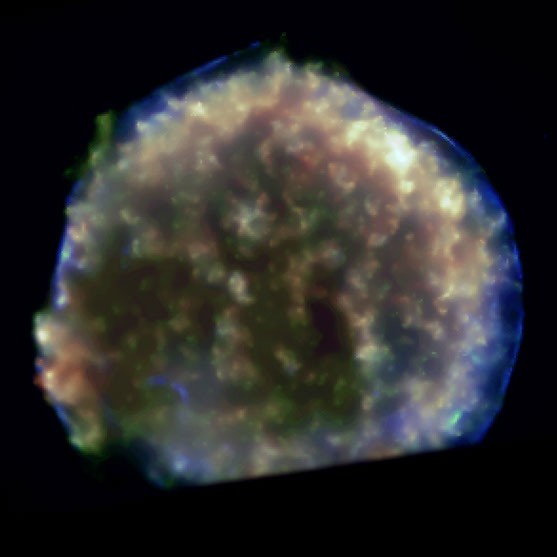
In 1572, Danish astronomer Tycho Brahe recorded the sudden appearance of a bright new star in the constellation Cassiopeia. The new star faded from view over a period of months and is believed to have been a supernova, one of the last stellar explosions seen in our Milky Way galaxy. Now known as Tycho's Supernova Remnant, the expanding debris cloud is shown in this detailed false-color x-ray image from the orbiting Chandra Observatory . Represented in blue, the highest energy x-rays come from shocked regions along the outer edges of the supernova remnant, corresponding to gas at temperatures of 20 million degrees Celsius. X-rays from cooler gas (only 10 million degrees or so!) dominate the remnant's interior. Unlike some other supernova remnants , no hot central point source can be found, supporting the theory that the origin of this stellar explosion was a runaway nuclear detonation that ultimately destroyed a white dwarf star. At a distance of about 7,500 light-years, Tycho's Supernova Remnant appears to be nearly 20 light-years across. This x-ray picture's field of view slightly cuts off the bottom of the generally spherical cloud.
X-Rays From Tycho's Supernova Remnant
Astronomy Picture of the Day · 2002-09-12 · NASA (public domain)
Advertisement
Advertisement
Advertisement