 Tukuk-OS
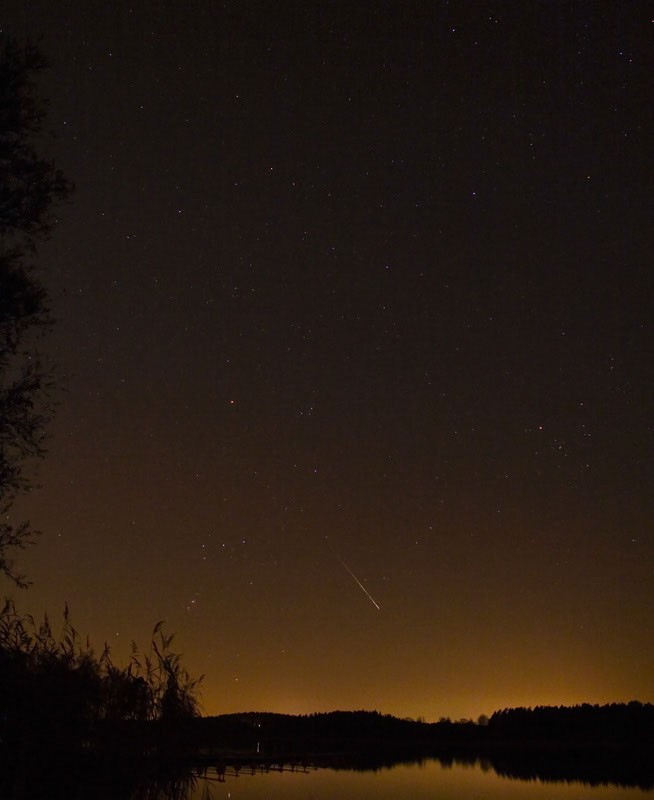
This past weekend, small remnant bits of a distant comet lit up the skies over much of planet Earth. Incoming reports , however, have this year's Leonid meteor shower as less active than Leonid meteor showers a few years ago . Nevertheless, some sky enthusiasts reported peak meteor bursts as high as one visual meteor per minute. The parent body of the Leonids meteor shower, Comet Tempel-Tuttle , leaves a trail of expelled sand-size particles every 33 years when it returns to the inner Solar System. When the Earth passes through a stream of these Sun-orbiting particles, a meteor shower results. Pictured above , a Leonid meteor was captured two days ago during the early morning hours of November 19 over Vallentuna , Sweden . Although activity levels in meteor showers are notoriously hard to predict, some astronomers speculate that Aurigids meteor shower next September might be unusually rich in bright meteors .
A Leonid Meteor Over Sweden
Astronomy Picture of the Day · 2006-11-21 · NASA (public domain)
Advertisement
Advertisement
Advertisement